
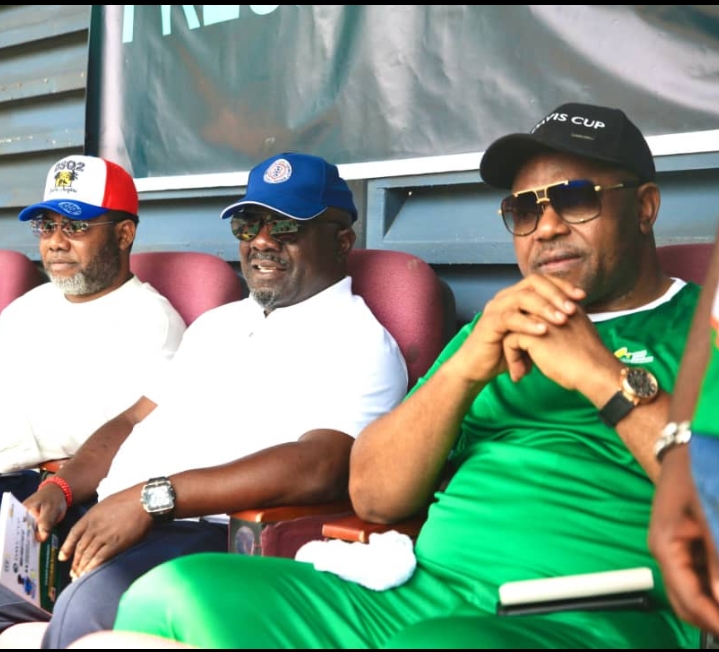
By Austin Edemodu, PhD
For nearly four decades, Nigeria’s return to the upper echelon of global tennis competition seemed like a distant dream.
The jinx of that long wait has now been broken under the leadership of Rt. Hon. Engr. Victor Ochei, President of the Nigeria Tennis Federation (NTF), as the country reclaims its place in the prestigious Davis Cup World Group I, a stage it last graced in the late 1980s.
Nigeria first participated in the Davis Cup in 1974, announcing its arrival on the global tennis map with confidence and flair.
The golden era of Nigerian tennis peaked in the 1970s and 1980s, producing world-class talents who competed fiercely on the international stage, including Nduka Odizor, who ranked among the world’s top 100 players and remains one of Nigeria’s greatest tennis exports.
Alongside him were distinguished names such as Christian Onyejekwe, Sadiq Abdullahi, and Tony Momoh, athletes who not only flew Nigeria’s flag at the Davis Cup but also brought global recognition to the nation’s tennis pedigree.
By 1988 and 1989, Nigeria had reached the Davis Cup Group I semifinals, a feat that symbolized the country’s growing influence in world tennis.
However, the momentum gradually waned in the decades that followed, despite flashes of promise in the 2000s from players such as Joseph Imeh, Sylvester Emmanuel, and Blessing Emmanuel, who made their mark in competitions like the Governor’s Cup Lagos Tennis Championship and the Lagos Open.
Today, history is repeating itself but with renewed vigor and strategic direction.
LAGOS: THE SPIRITUAL HOME OF NIGERIAN TENNIS
The choice of Lagos as host city for the 2026 Davis Cup World Group I Playoff against Uzbekistan was no coincidence as Lagos has long stood as the heartbeat of Nigerian tennis development.
From the iconic Lagos Lawn Tennis Club (founded in 1895) to the Ogbe Hard Court once a fertile ground for discovering and nurturing budding talents, the city remains a beacon of tennis excellence.
Under Victor Ochei’s stewardship, Nigeria successfully hosted the high-profile playoff tie against Uzbekistan, an event that drew international commendation and reaffirmed Nigeria’s organizational and competitive readiness. It was more than just a tournament; it was a statement of intent.
THE OCHEI EFFECT: VISION, LEADERSHIP AND RESULT
Engineer Victor Ochei is widely regarded as not only a passionate lover of tennis but an encyclopedic authority on the sport, both locally and globally.
Since assuming office, he has demonstrated clarity of vision, administrative discipline, and a deep commitment to rebuilding Nigeria’s tennis ecosystem.
In just a few months at the helm, Ochei has reignited belief within the tennis community. His ability to secure the confidence and support of the International Tennis Federation (ITF) to stage a crucial playoff in Lagos underscores his credibility and strategic engagement at the international level.
Importantly, he has built on the foundation laid by his predecessor, late Engineer Ifedayo Akindele (Akinjobi), ensuring continuity rather than disruption. This blend of consolidation and innovation is gradually restoring a winning culture within the federation.
A NEW GENERATION RISING
Perhaps the strongest evidence of Nigeria’s tennis renaissance lies in its emerging talents. The current squad, including Nigeria’s number one, Daniel Adeleye, alongside Canice Abua, Michael Emmanuel, Alafia Ayeni, and Bulus Christopher, represents a new wave of technically sound, mentally resilient players ready to compete on the global stage.
Their qualification for the Davis Cup World Group I, which features 25 of the world’s competitive tennis nations, marks Nigeria’s return to elite company after almost four decades of absence.
This achievement is not accidental; it reflects improved talent management, structured exposure, and a renewed focus on performance excellence.
ALIGNING WITH NATIONAL SPORTS POLICY
Ochei’s leadership also aligns with the broader sports development vision of the National Sports Commission under Malam Shehu Dikko and Bukola Olopade, in tandem with President Ahmed Bola Tinubu’s renewed hope agenda for sports economy and development.
The synergy between Federation leadership and national sports authorities has created an enabling environment for growth, investment and international competitiveness.
RESTORING THE WINNING CULTURE
Reviving a winning culture goes beyond victories on the court. It involves rebuilding confidence, strengthening the grassroots structure, attracting sponsorship, ensuring international exposure, and fostering administrative transparency.
Under Victor Ochei, these elements are gradually taking shape. There is renewed optimism among players, coaches and stakeholders. There is a direction in planning, there is action in implementation, and most importantly, there is measurable progress.




Senator Nwoko’s Strategic Leadership, National Influence, People-Centered Representation